Early in my PhD, I started working with the Variable Infiltration Capacity (VIC) model in the Krishna River Basin, India. My first task was to calibrate the model against observed streamflow. I did not know quite what to expect, only that somewhere among the many possible parameter sets, one would give the best result. Instead, I found several parameter sets, quite unlike one another, that matched the observed flow almost equally well. Yet each set represented the basin’s hydrology differently, most visibly in the partitioning of rainfall among surface runoff, baseflow and evapotranspiration. Streamflow data could not tell me which of these representations was right, or whether any of them was.
A few months later, I came across Keith Beven’s A manifesto for the equifinality thesis (Journal of Hydrology, 2006), which helped me understand my calibration results. Equifinality is the idea that many different models, or parameter sets within one model, can reproduce the same observations equally well. The term comes from Ludwig von Bertalanffy’s general systems theory, where it describes open systems that reach the same final state from different starting conditions and by different paths. Beven first used it in hydrology in 1993, and the manifesto, written thirteen years later, is his most complete statement of the idea. He argues that equifinality is a general property of environmental models, because our observations are uncertain, our input data contain errors, and every model simplifies the real system. Given these limitations, a single optimal parameter set is difficult to justify. He proposes treating each parameter set as a hypothesis about how the basin works, and rejecting any that fail to match the observations within an acceptable error range. The parameter sets that survive are called behavioural, and all of them are carried forward into prediction.
After reading the paper, my aim in calibration shifted from finding one parameter set to identifying all the combinations the data could support. GLUE, the method Beven and Andrew Binley introduced in 1992, gave me a practical way to do this, by weighting each acceptable parameter set according to how well it matched the observed streamflow. The method has been criticised because the choice of likelihood measure and acceptance threshold rests with the modeller, and it was debated at length against formal Bayesian approaches. Sobol sensitivity analysis showed that a few parameters controlled most of the simulated flow, while several others had little effect on it. This explained why the calibration had produced so many good fits, since the parameters that streamflow could not constrain were free to vary. Sensitive parameters could also compensate for one another. The clearest case was the trade-off between the infiltration shape parameter and the depth of the soil layers, where a thin soil that shed rain quickly and a deep soil that held it longer produced nearly the same hydrograph.
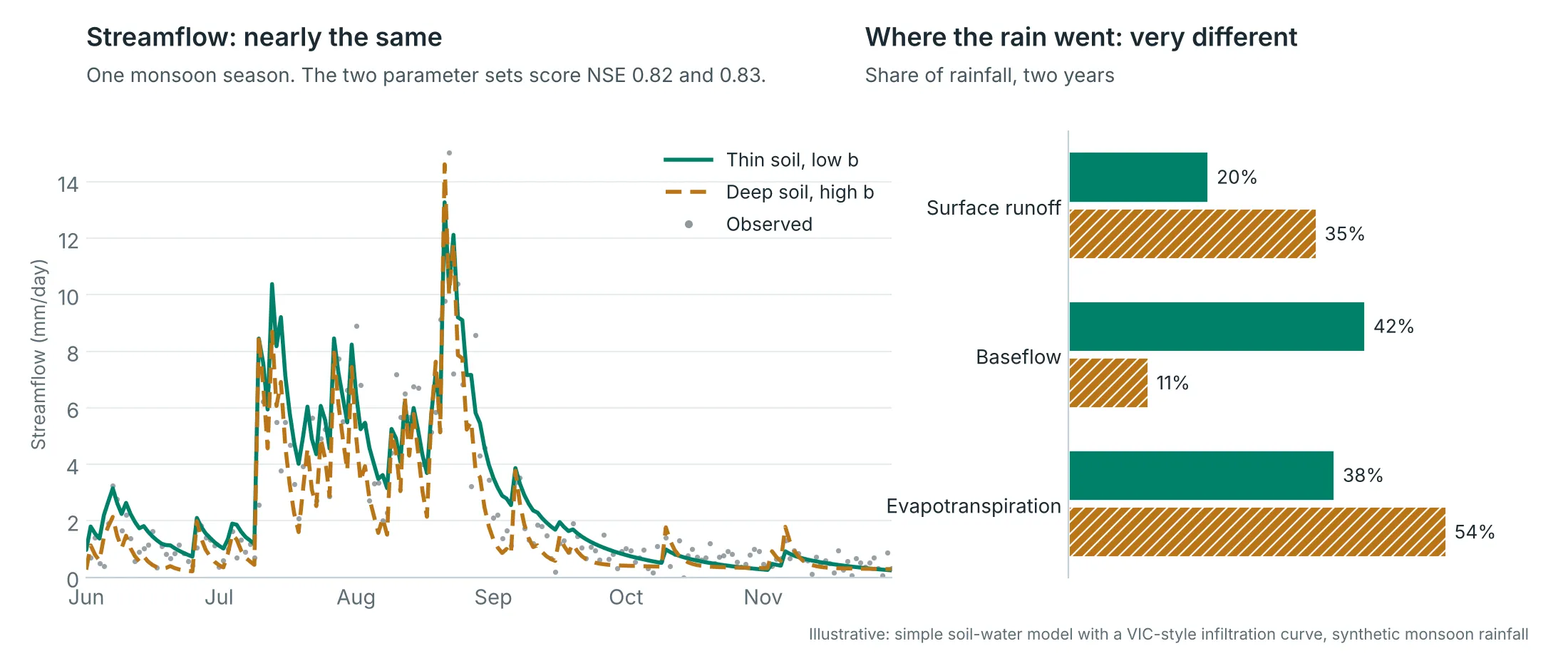
Nearly twenty years after its publication, the paper has only grown more relevant. Hydrological models now span entire continents, and machine learning can reproduce observed streamflow with high accuracy. Neither guarantees what James Kirchner, writing in the same year, called getting the right answers for the right reasons. Parameter sets that agree on past observations can give very different projections when a model is applied beyond the conditions it was calibrated for, whether under a changing climate, altered land use or in ungauged basins. Much of the progress since 2006 has come from new ways of judging which acceptable parameter sets represent the basin’s processes realistically. Models are now evaluated against hydrological signatures as well as overall fit, and satellite observations of soil moisture, evapotranspiration and water storage help constrain their internal behaviour. Frameworks such as FUSE and SUMMA allow alternative process equations to be compared within one model, so that a model’s structure can be tested as well as its parameters. For anyone about to begin, Beven’s manifesto is worth reading before their first model calibration.
Further reading
- Beven, K. (2006). A manifesto for the equifinality thesis. Journal of Hydrology. doi:10.1016/j.jhydrol.2005.07.007
- Beven, K. and Binley, A. (1992). The future of distributed models: model calibration and uncertainty prediction. Hydrological Processes. doi:10.1002/hyp.3360060305
- Beven, K. (1993). Prophecy, reality and uncertainty in distributed hydrological modelling. Advances in Water Resources. doi:10.1016/0309-1708(93)90028-E
- Kirchner, J. W. (2006). Getting the right answers for the right reasons: linking measurements, analyses, and models to advance the science of hydrology. Water Resources Research. doi:10.1029/2005WR004362